
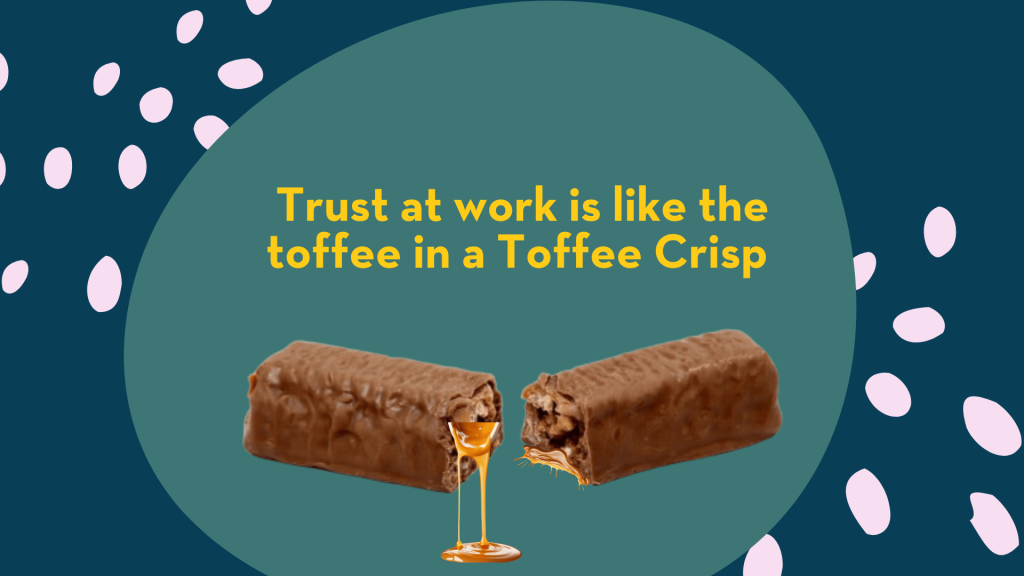
Isn’t it a brilliant visual metaphor? I can’t take full credit, the fabulous non-profit leaders in my Sweet Spot Inner Circle came up with it a while back.
Trust really is the delicious, sticky, addictive yumminess that keeps collaboration, productivity, creativity and joy alive in your organisation.
When you have it, working life is sweet and things get done.
When you don’t, all those good things vanish to the detriment of everyone – users and beneficiaries, the staff team, trustees and collaborators. Really. The lack of trust will spread everywhere like a virus.
When there’s no trust, you can’t really call your team a team. It’s a bunch of people protecting their own interests, and that is not good news.
So how do you spot the signs that trust is shaky in the first place?
Here are five tell-tale signs you have a trust problem.
1. There are long, painful silences in meetings
On the whole, people don’t speak in a meeting because they don’t trust that it’s a safe environment in which to do so. Perhaps they don’t trust that their contribution will be valued. Perhaps they fear they will be put down or ignored entirely. Perhaps they are safer keeping their ideas to themselves. I had that very experience when I worked for a very well-known heritage charity where there was nil trust in my team – mentioning no names, natch – It was truly horrible.
It’s generally not because they really don’t have anything to say.
(Talking of meetings, when everyone in the senior team wants to go to every single high-level meeting, that’s a sure sign that your colleagues don’t trust each other.)

2. Team members would rather struggle on than ask for support
There are a whole heap of reasons why we don’t seek support from others even when we’re snowed under or out of our depth – and it all boils down to trust.
Your team won’t seek help if they don’t believe you, or their colleagues, have a valuable contribution to make. They might not trust that you have the skills or knowledge to be of any use whatsoever.
Or, they don’t trust that admitting they need help is acceptable in the culture of the organisation. This is particularly sensitive right now, with restructures and redundancies on the increase. Can team members truly trust that admitting they’re not quite on it is won’t be a reason to move them on.
Sounds familiar?
3. You notice people sitting on their ideas
When team members don’t share their thoughts and ideas, or seem unwilling to collaborate, it’s because they don’t trust others to support them. Maybe they’re protecting their own corner of work, or they fear their ideas will be commandeered by someone else.
I’ve had this last experience and it totally shut down my willingness to collaborate to the detriment of our team. When you see colleagues disengaging, isolating and hunkering down, you know you have a trust problem.
4. You see the ‘same old, same old’ approaches being rolled out
When your team aren’t coming up with new, innovative ideas to solve challenges and problems, it might well be because they don’t have the skills, or, it may be more of a cultural issue. Is there a lot of judgement and negativity in your organisation? Is there finger-pointing and blame when things go wrong?
If that’s the case, your team will simply not trust that it’s okay for new things not to work, so ‘surprise!’, they won’t come up with any. They’ll worry they’ll be criticised and seen as failing, rather than encouraged to view their experience as valuable learning.
And, when you hear the tired response of ‘we tried that and it didn’t work’, it’s the same trust issue – you may have a culture where it’s simply not okay for things not to work first time.
5. There’s a lot of gossip and emotion going around
In a happy, trusting work environment, if problems with a colleague come up, they are dealt with quickly and directly. If you have an issue with someone, you just go and talk to them and sort things out.
A sure sign that trust between colleagues has been eroded, is when there’s gossip and explosive emotion left, right and centre, but little direct, open communication. People don’t trust themselves to cope with a difficult conversation or they don’t trust the other to deal with what they have to say.
Either way, it’s all about trust.

Over to you?
How many of these tell-tale signs feel familiar to you? Do you think – or actually know – that trust is an issue in your organisation? I hear from some of my coaching clients that once this way of mistrustful working becomes the norm, it’s tricky to imagine a different way of doing things. But it really is possible to build trust up again.
What’s next?
Got a trust issue in your team? Doing the important work of rebuilding trust takes courage and can be hard on your own. I’m here to help. Email me katie@katieduckworth.com or fill in the form below and I’ll get back to you right away.


