

Argh! Do you feel like the CEO who said this to me recently?
Your brain is whizzing at a thousand miles an hour.
Your desk is a swamp and your phone rarely stops buzzing.
You’re taking work home way more than you used to.
There’s so much coming at you that there isn’t time or space to get your head down and some decent work done.
You’re just about holding it together.
And of course, the imposter syndrome is getting louder and louder.
Ugh.
This is not funny
I feel for you. I really do.
In the last 12 months pretty much every mission-driven leader I coach has been feeling something like this.
The current climate is dire.
And what that means, for you, totally fabulous leader, is a whole lot of frazzle, frustration and fury, even.
I see it every single day in my coaching with voluntary sector and mission-driven leaders.
So – what the hell is the answer?
Well, I bet there are a whole bunch of things you wish for that, sadly, are not within your power to create. I so wish I could wave a magic wand and make them happen.
But right now, let’s focus on what IS in your sphere of control.
You can’t create more time, right? But you can make a really powerful tweak to how you use it.
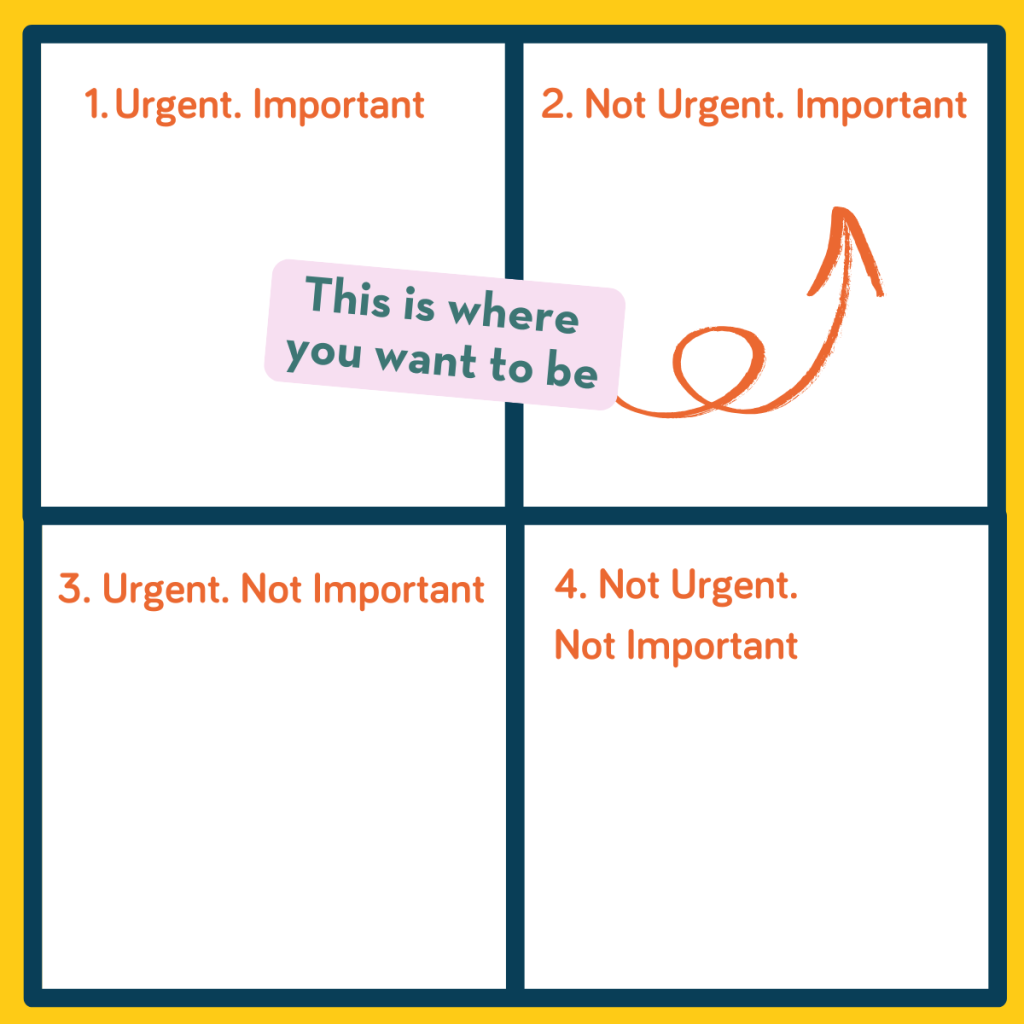
I’ve been going back to basics with the leaders I coach with a model I’ve been teaching for years – the Urgent/Important Grid (Thank you, Stephen Covey and your book The Seven Habits of Highly Effective People).
I’m all about bringing playfulness and fun into leadership. But today, I’m encouraging you to take your Not Urgent, but Important activities – in Stephen Covey’s Quadrant 2 (Q2) – super seriously.
So you get to say goodbye to overwhelm, this is where you want to spend as much of your time as you possibly can. Q2 work won’t be Urgent – but it sure is Important, with a Capital ‘I’.
Three-steps to overcoming overwhelm
1. Know what’s in Q2
All activities will have a place in one of these four quadrants. I notice that my clients can be a wee bit vague about this. But knowing what the most important work is essential if you’re to get on it.
It’s particularly important to know your Q2 activities – your priorities.
Everyone’s Q2 work will be different. What are the core tasks that are expected of you. The priorities in your JD. The work that no-one else has responsibility for doing. The activities that contribute to your vision, mission and high-value goals.
For leaders, Q2 activities include, liaising with your Chair, writing a strategy paper, looking for new opportunities, building relationships inside and out of your organisation.
But here’s the thing. At work, if Q2 tasks don’t get done, they sometime just fall off the grid completely and have dire consequences down the line, or more often they head straight on across the invisible line into Q1. And you do not want to be in here.
This is where you’re doing all that firefighting. Where the sense of overwhelm comes from. When everything is Urgent and Important – and feels like it too.
This is where stress and crisis live.
So, what’s in your Quadrant 2? How about taking a look now.
2. Block time in your diary for Q2 work
Once you’re clear what’s in Q2, get a gorgeous metaphorical pen and draw a thick line around some 100% untouchable time in your diary.
Ideally you want to be spending 80% of your time in Q2! Feels like a lot? Yep, I get that. How about chunking in a half day a week for your Q2 tasks to start off with?
And the secret to actually getting to this work?
– protect this time as if it was the most precious thing ever (which in fact it is). The success of your mission will truly depend on getting it done.
– chunk the time right back in again if it disappears to the unexpected or unplanned. NB – This is the bit where you can sabotage yourself big-time.
3. Find a way to deal with Q1, 3 & 4 tasks
Battering away at the edges of your Q2 and in danger of fully taking over, are all the other jobs in all the other quadrants. I encourage you to come up with a few personal, must-follow habit and strategies that will keeping them away from your precious Q2-time.
Ideas from my coaching clients:
- Be realistic and don’t over-schedule your day so there is always flexibility for urgent and important Q1 tasks to be managed
- Cluster less important work at times when your brain is less lively
- Know what is truly urgent. An email, WhatsApp or phone call is in Q3, until you find out that it’s not. This one is truly a game-changer. Just because it’s happening now, or is very loud or insistent, doesn’t mean its Important and Urgent.
- Learn to say ‘no’ more. (Yes! There’s a whole blog or five in there, I know. I’ll get to it.)
Over to you
So, how does all this sound to you? I imagine you might be doing some of it already, in which case, you could find that it’s the tweaks that really make the difference.
And if it feels just impossible, chunk just one hour of Q2 tasks in, protect it with your life, and see how that feels. You’ll want to do more.
What’s next?
Would you value my help with tackling overwhelm? Email me at katie@katieduckworth.com and let’s talk about coaching together.


